Florida is known for its waterfront homes, canals, bays, rivers, and coastal communities. For many property owners, protecting the shoreline is an important part of maintaining the property.
That is where seawalls in Southwest Florida can play an important role.
A seawall creates a barrier between the land and the water. It can help reduce shoreline erosion, protect waterfront property, and provide support along canals and other waterways. However, a seawall is not a simple structure that can be installed the same way at every property.
Water depth, soil conditions, tides, waves, drainage, erosion, materials, and local regulations can all affect the design.
Whether you are building a new seawall, looking for Punta Gorda seawall repair, replacing an aging wall, or comparing shoreline seawalls, it is important to understand how these structures work and what affects their cost and lifespan.
This guide explains the basics of seawalls in Florida, including the main types, average costs, repairs, materials, maintenance, and how to choose a marine contractor.
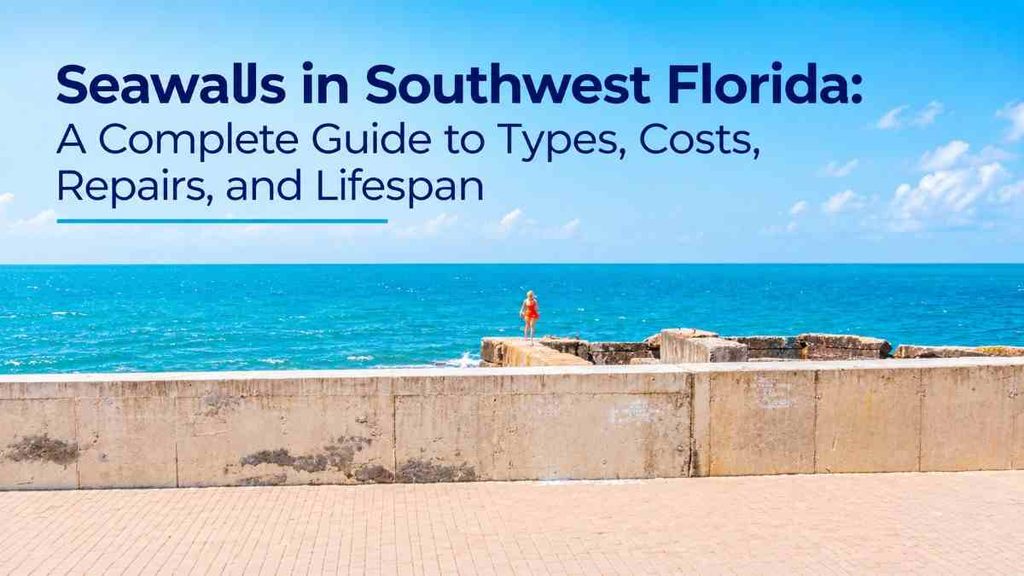
What Is a Seawall?
A seawall is a structure designed to separate land from a body of water.
It is commonly installed along:
- Residential canals
- Rivers
- Bays
- Coastal properties
- Marinas
- Waterfront commercial properties
- Lakefront properties
- Other developed shorelines
The main purpose is to help protect the shoreline from erosion and water movement.
A seawall can also provide a stable edge for a waterfront property. In some cases, it may work together with a dock, boat lift, seawall cap, drainage system, or other waterfront improvements.
However, a seawall does not stop every type of erosion or water damage. Its design needs to match the site and the forces acting on the shoreline.
Are There Seawalls in Florida?
Yes. Seawalls are common in Florida, especially around developed waterfront areas.
Florida has thousands of miles of coastline as well as extensive networks of canals, rivers, bays, and other waterways. As a result, waterfront properties often need some form of shoreline protection.
Seawalls are used in many parts of the state, including:
- Southwest Florida
- Southeast Florida
- Tampa Bay
- Sarasota
- Fort Myers
- Cape Coral
- Punta Gorda
- Port Charlotte
- Naples
- Bonita Springs
- Marco Island
- Miami
- Fort Lauderdale
- Jacksonville
- Other waterfront communities
The type of shoreline protection used depends on the property and the waterway.
Florida’s Department of Environmental Protection regulates many activities involving surface waters, coastal construction, docks, and shoreline work. DEP’s Southwest District, for example, handles permitting and authorization for activities that include coastal construction and residential and commercial docks.
Why Are Seawalls Important in Florida?
Florida’s waterfront properties can experience several environmental challenges.
Water movement can slowly remove soil from the shoreline. Waves can place additional pressure on the edge of the property. Tidal changes can expose and submerge different sections of the shoreline.
Storms can also increase wave energy and water movement.
Over time, these conditions may contribute to:
- Soil erosion
- Shoreline loss
- Cracks
- Settlement
- Seawall leaning
- Sinkholes or voids behind the wall
- Damaged caps
- Corroded components
- Drainage problems
- Damage to nearby docks
A properly designed seawall can help manage these risks.
However, seawalls should be viewed as part of a larger waterfront system rather than an isolated structure.
What Are the Three Types of Seawalls?
There are several ways to classify seawalls, but three common categories are vertical seawalls, curved or stepped seawalls, and riprap or sloped shoreline protection.
The right option depends on the property, water conditions, available space, and project requirements.
1. Vertical Seawalls
Vertical seawalls create a relatively straight barrier between land and water.
They are commonly used along developed waterfront properties where space is limited.
A vertical wall can be constructed from materials such as:
- Steel sheet piles
- Concrete
- Vinyl sheet piles
- Other engineered marine materials
These walls can work well along residential canals where the property needs a defined waterfront edge.
2. Sloped or Riprap Shoreline Protection
Riprap uses rocks or other durable materials placed along the shoreline.
Instead of creating a vertical wall, the shoreline has a sloped protective surface.
This approach can absorb some water energy and may work well where there is enough land available for a slope.
However, it requires more shoreline space than a vertical wall.
3. Curved or Specialty Seawalls
Some waterfront projects use curved, stepped, or specially engineered wall designs.
The design may be selected based on:
- Wave conditions
- Property layout
- Water depth
- Soil
- Available space
- Existing structures
- Engineering requirements
The important point is that seawall design should be site-specific.
There is no universal seawall design that is appropriate for every Florida property.
What Are Shoreline Seawalls?
Shoreline seawalls are structures designed to protect the edge of a waterfront property.
They can help reduce the effects of erosion and provide a more stable boundary between land and water.
Shoreline seawalls may be found around:
- Residential homes
- Waterfront communities
- Marinas
- Commercial properties
- Canals
- Rivers
- Bays
The design can vary considerably.
For example, a seawall along a quiet residential canal may face different conditions from a wall directly exposed to coastal waves.
That difference should be considered before selecting materials or construction methods.
Seawall Materials Used in Florida
The material used for a seawall can affect its cost, maintenance needs, appearance, and expected service life.
Common materials include:
Vinyl Sheet Pile
Vinyl seawalls are used in many residential waterfront applications.
Benefits can include:
- Corrosion resistance
- Low maintenance
- Clean appearance
- Long service life when properly installed
Steel Sheet Pile
Steel can provide high structural strength.
However, corrosion protection is especially important in a marine environment.
Concrete
Concrete may be used for seawall caps and other structural components.
It can provide a durable finished surface when properly designed and maintained.
Timber
Older waterfront properties may have timber seawalls.
Timber can be vulnerable to decay, marine organisms, and long-term water exposure. As a result, an older timber seawall may eventually require significant repair or replacement.
How Much Does a Seawall Cost in Florida?
One of the most common questions homeowners ask is:
“How much does a seawall cost in Florida?”
There is no single price that applies to every Florida seawall.
The final cost depends on factors such as:
- Seawall length
- Wall height
- Material
- Water depth
- Soil conditions
- Access to the property
- Existing wall condition
- Required engineering
- Dock connections
- Removal of an old wall
- Drainage
- Permitting
- Environmental requirements
- Labor
- Equipment
- Site conditions
For that reason, online cost estimates should be treated as general planning figures rather than a quote.
A short residential seawall may cost significantly less than a long wall requiring major excavation, piling work, demolition, or difficult water access.
What Can Increase Seawall Cost?
Several site conditions can increase the project price.
For example, replacing an existing seawall can involve much more work than installing a wall on a cleared site.
The contractor may need to remove:
- Old sheet piles
- Concrete
- Timber
- Broken caps
- Failed anchors
- Damaged sections
The contractor may also need to stabilize the soil behind the wall.
As a result, a professional site inspection is one of the best ways to establish a realistic project budget.
What Is the Cost of Seawall Repair in Florida?
Seawall repair costs can vary even more than new construction costs.
A small repair may involve replacing a limited section or repairing a damaged cap.
A major repair may require reconstruction of a large portion of the wall.
Common repair work includes:
- Replacing damaged sections
- Repairing seawall caps
- Installing additional support
- Filling voids
- Improving drainage
- Replacing damaged tiebacks
- Addressing erosion behind the wall
- Replacing deteriorated materials
The most important step is identifying the cause of the damage.
For example, repairing a visible crack without addressing soil loss behind the wall may not solve the underlying problem.
Punta Gorda Seawall Repair
Punta Gorda is an important waterfront community in Southwest Florida, with residential properties connected to canals and waterways.
For homeowners searching for Punta Gorda seawall repair, the first step should be a professional inspection.
A seawall inspection should look for:
- Cracks
- Leaning
- Bulging
- Settlement
- Soil loss
- Voids
- Corrosion
- Damaged caps
- Exposed support components
- Drainage problems
- Separation between wall sections
A small problem can sometimes be repaired before it becomes a larger structural issue.
However, severe movement or widespread deterioration may indicate that replacement is more appropriate than another temporary repair.
Dock Builders in Punta Gorda, FL
Seawalls and docks often work together.
If you are searching for dock builders in Punta Gorda, FL, consider whether your dock and seawall should be inspected as part of the same project.
A dock may connect directly to a seawall or rely on nearby waterfront structures for access and support.
Local businesses serving the Punta Gorda area include Marine Contracting Group Inc, Premier Dock and Lift Services, and Parr Marine Construction Inc. These are examples of local marine and dock-related businesses, not rankings or endorsements.
When choosing a contractor, look at experience, licensing, insurance, project scope, permitting knowledge, materials, and references.
How Long Do Seawalls Last in Florida?
Another common question is:
“How long do seawalls last in Florida?”
There is no guaranteed lifespan for every seawall.
A seawall’s service life depends on:
- Construction quality
- Materials
- Water conditions
- Saltwater exposure
- Soil conditions
- Wave energy
- Maintenance
- Drainage
- Storm exposure
- Installation method
- Age of the structure
A properly designed and maintained seawall can last for decades, but older seawalls should still be inspected regularly.
The material makes a major difference.
For example, an older timber seawall may have different maintenance needs from a modern vinyl or steel sheet-pile system.
Signs Your Seawall May Need Repair
Do not wait until a seawall completely fails before having it inspected.
Look for warning signs such as:
Cracks
Cracks in the seawall or cap can indicate movement or deterioration.
Leaning
A wall that is visibly leaning toward the water may have structural problems.
Bulging
Bulging can indicate pressure or movement behind the wall.
Sinkholes or Depressions
A depression behind the wall may indicate that soil is moving into the water.
Gaps
Gaps between wall sections can allow soil to escape.
Exposed Materials
Exposed steel, tiebacks, or other components may indicate deterioration.
Water Flow
Unexpected water movement through or behind the wall can be a warning sign.
Damaged Seawall Cap
A damaged concrete cap can allow water to reach areas that should remain protected.
Why Drainage Matters Behind a Seawall
A seawall does more than hold back water from the canal or shoreline.
It also needs to deal with water on the land side.
Rainwater can collect behind the wall. Without proper drainage, hydrostatic pressure can increase.
This pressure can place additional force on the seawall.
Proper drainage may include systems such as:
- Weep holes
- Drainage pipes
- Gravel
- Filter fabric
- Other engineered drainage solutions
The correct system depends on the site.
This is one reason a seawall should be designed as a complete system rather than simply placing a wall along the edge of the property.
Seawalls and Florida Storms
Florida’s storm season is another reason waterfront property owners pay close attention to seawall condition.
Strong storms can bring:
- High water
- Heavy rain
- Waves
- Wind
- Increased water movement
- Debris
A seawall that already has structural problems may be more vulnerable during severe weather.
This does not mean a seawall can prevent all storm damage.
Instead, regular inspection and maintenance can help identify existing problems before the next major storm.
Seawall Replacement vs. Seawall Repair
Should you repair your seawall or replace it?
The answer depends on its condition.
Repair may be suitable when:
- Damage is limited
- The main structure remains stable
- Only certain sections are deteriorated
- The seawall cap needs repair
- Drainage needs improvement
- A localized area has failed
Replacement may be considered when:
- Large sections have failed
- The wall is severely leaning
- There is extensive corrosion
- Soil is escaping behind the wall
- Structural support has deteriorated
- The existing wall is near the end of its useful service life
A professional inspection can help determine the appropriate option.
How to Maintain a Seawall in Florida
Regular maintenance can help extend the life of a seawall.
Consider scheduling periodic inspections.
During an inspection, look for:
- New cracks
- Wall movement
- Soil loss
- Corrosion
- Damaged caps
- Drainage issues
- Vegetation problems
- Gaps between sections
Keep drainage systems clear.
Also, avoid placing unnecessary heavy loads close to the seawall without professional review.
If you see a new problem, address it early.
A small repair can sometimes prevent a much larger waterfront project.
Do Seawalls Require Permits in Florida?
Potentially, yes.
The permitting requirements depend on the location, type of work, waterbody, project design, and applicable environmental rules.
Florida DEP’s Environmental Resource Permitting program regulates many alterations to Florida’s land surface and waters. DEP also provides specific permitting resources for shoreline stabilization.
Some coastal projects can involve additional authorization.
For example, DEP states that a Joint Coastal Permit is required for certain activities on Florida’s natural sandy beaches that extend seaward of mean high water and into sovereign submerged lands.
Federal authorization can also be relevant to certain shoreline stabilization projects. DEP notes that its State Programmatic General Permit includes certain shoreline stabilization activities.
Therefore, homeowners should not assume that a seawall repair or replacement automatically falls under the same permit process everywhere in Florida.
A qualified contractor should review the project requirements before construction begins.
Why Local Experience Matters for Florida Seawalls
Florida has many different waterfront environments.
A property in Punta Gorda can have different conditions from one in Naples, Tampa, Fort Lauderdale, or Jacksonville.
Local conditions may include:
- Canal systems
- Tidal waterways
- Saltwater
- Brackish water
- Soft soils
- Coastal exposure
- Existing seawalls
- Aging docks
- Different local requirements
That makes local experience valuable.
A marine contractor should understand how waterfront structures interact with the property, waterway, and surrounding environment.
Southern Marine Contractors and Seawall Projects
Homeowners may search for terms such as Southern Marine contractors, marine construction companies, seawall contractors, dock builders, or waterfront construction companies when planning a project.
However, the company name is not the most important factor.
Instead, compare contractors based on:
- Relevant marine construction experience
- Seawall repair experience
- New seawall construction
- Dock construction
- Boat lift experience
- Permitting knowledge
- Insurance
- References
- Project scope
- Materials
- Warranty
- Maintenance and repair services
Ask for a detailed written proposal before beginning major work.
How to Choose a Seawall Contractor in Florida
Choosing the right contractor can have a major effect on the long-term performance of your seawall.
1. Check Marine Construction Experience
Seawall work is different from ordinary land-based construction.
Look for experience with waterfront structures.
2. Ask About the Materials
Ask which materials will be used and why they are appropriate for your property.
3. Request a Site Inspection
A contractor should understand the existing conditions before providing a final recommendation.
4. Ask About Permits
Confirm which permits or approvals may apply.
5. Get a Detailed Estimate
The proposal should explain the work clearly.
6. Ask About Existing Damage
If your current seawall is failing, ask whether repair or replacement is the better long-term option.
7. Consider the Entire Waterfront
If you also have a dock or boat lift, ask whether those structures should be inspected at the same time.
Seawalls and Docks: Why They Should Be Considered Together
A waterfront property often contains several connected structures.
For example:
Home → yard → seawall → dock → boat lift → boat
A problem with one component can affect another.
A failing seawall may affect the area around a dock.
Likewise, changing a seawall may affect the way a dock connects to the waterfront.
That is why it can be helpful to work with a marine contractor who understands multiple waterfront systems.
Custom Dock & Davit provides marine construction services focused on docks, boat lifts, seawalls, repairs, piling replacement, decking, and waterfront improvements in Southwest Florida.
Frequently Asked Questions About Seawalls in Florida
Are there seawalls in Florida?
Yes. Seawalls are widely used along developed waterfront properties, canals, rivers, bays, and coastal areas throughout Florida.
What are the three types of seawalls?
Common categories include vertical seawalls, sloped or riprap shoreline protection, and specialty designs such as curved or stepped walls. The appropriate design depends on the property and water conditions.
How much does a seawall cost in Florida?
The cost varies based on length, height, material, water depth, soil, access, existing structures, demolition, engineering, permits, and site conditions. A professional inspection is needed for an accurate project estimate.
How long do seawalls last in Florida?
A seawall can last for decades when properly designed, installed, and maintained. However, lifespan varies significantly based on material, water exposure, soil, storms, construction quality, and maintenance.
What are the signs of a failing seawall?
Common warning signs include leaning, cracks, bulging, soil loss, sinkholes, gaps, corrosion, damaged caps, and unusual water movement behind the wall.
Can a damaged seawall be repaired?
Yes, depending on the damage. Localized problems may be repairable, while severe structural deterioration may require replacement.
Do seawalls prevent erosion?
A properly designed seawall can help protect a developed shoreline from erosion, but it does not eliminate every source of erosion or water damage.
Do seawalls require permits in Florida?
Many waterfront construction and shoreline stabilization projects are regulated. Requirements depend on the location and scope of work. Florida DEP provides permitting and self-certification resources for applicable projects.
Can a seawall and dock be built together?
Yes. In some waterfront projects, the seawall, dock, pilings, and boat lift are planned together. This can help ensure that the structures work properly as one waterfront system.
Final Thoughts on Seawalls in Florida
A seawall is an important investment for many Florida waterfront properties.
Whether you need seawalls in Southwest Florida, shoreline seawalls, Punta Gorda seawall repair, or a complete waterfront upgrade, the right solution depends on the property and the conditions around it.
Start by inspecting the existing structure.
Then consider the seawall’s material, age, drainage, support system, water exposure, and visible signs of damage.
Most importantly, do not choose a seawall based only on the lowest price. A properly designed and installed structure can provide long-term shoreline protection and help support other waterfront improvements.
Custom Dock & Davit can help Southwest Florida property owners evaluate their seawall, dock, boat lift, piling, and other marine construction needs. A professional site assessment can help determine whether repair, replacement, or a new waterfront structure is the right approach for your property.